Mold-Tech Textures: Series, Draft Angle and How It Works
Mold Texture Standards
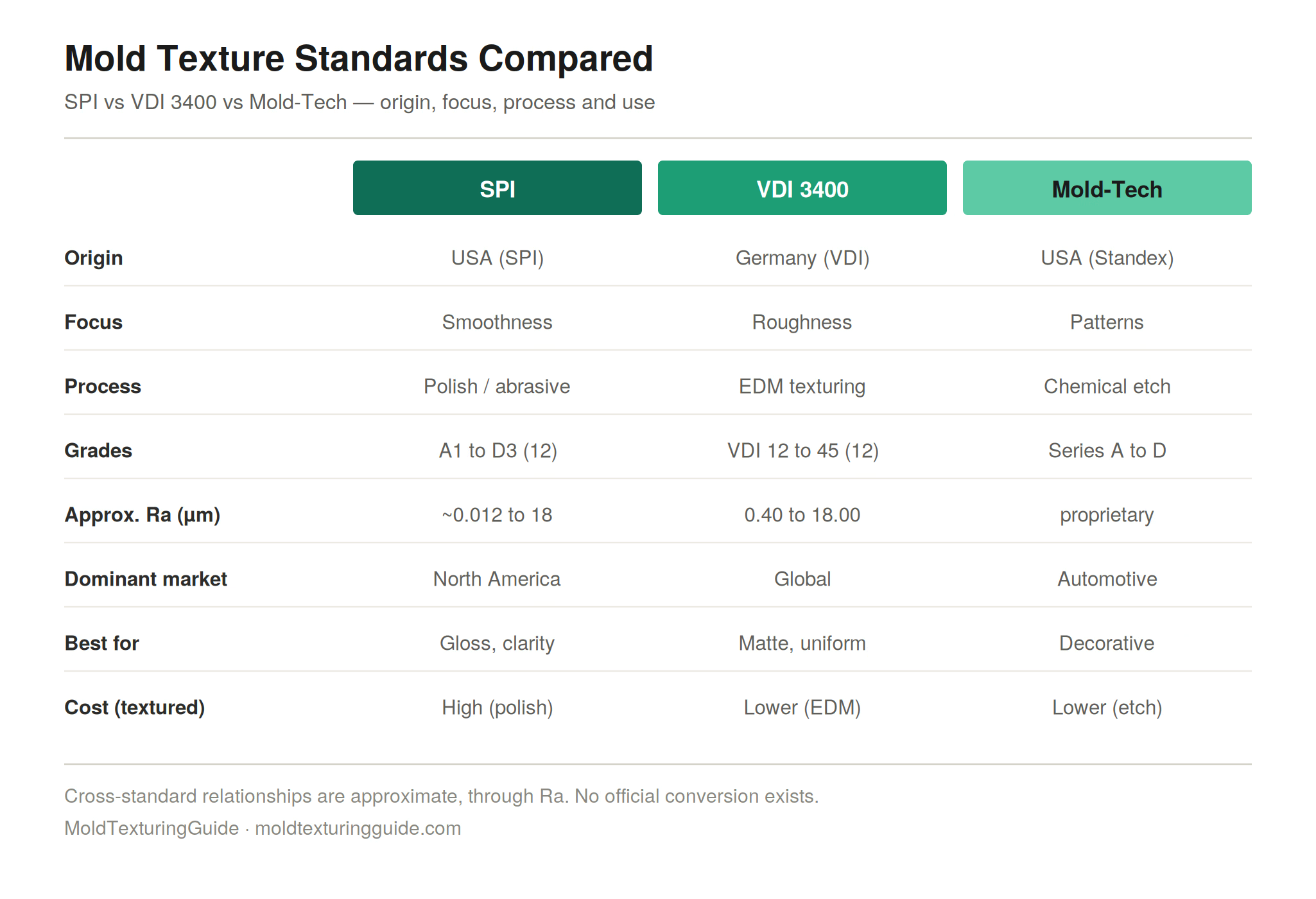
Mold texture standards specify the surface finish of an injection mold cavity, which transfers directly to the molded part. The three dominant systems are SPI (a US polish standard focused on smoothness), VDI 3400 (a German standard focused on EDM-textured roughness), and Mold-Tech (a proprietary pattern library). SPI and VDI 3400 together account for roughly 90% of mold texture references in use. They relate to one another only approximately, through surface roughness (Ra), and no official conversion exists between them. This guide explains what each standard is, how they differ, and how to choose, then points to the detailed reference page for each.
What are mold texture standards?
In injection molding, the surface of the mold cavity is reproduced on every part it forms. A cavity polished to a mirror produces a glossy or optically clear part; a cavity that carries a fine matte texture produces a matte part; a cavity engraved with a leather grain produces that grain on the product. Because the finish is built into the tool, it must be specified before the mold is cut, and it must be specified in a language that the toolmaker, the molder, and the buyer all understand the same way.
That shared language is what a mold texture standard provides. Instead of a vague request such as “make it matte,” a standard lets an engineer write a specific grade, such as SPI C-1 or VDI 3400 grade 27, that corresponds to a defined surface roughness and appearance. The standard removes ambiguity, makes quotes comparable between suppliers, and allows a finish to be reproduced consistently across production runs and across different molds.
Three standards dominate the industry worldwide: SPI, VDI 3400, and Mold-Tech. A fourth, Yick Sang, is common in parts of Asia. Each was created for a different purpose and measures the surface in a different way, which is why they cannot be converted into one another exactly. Understanding what each one is for is the first step in specifying a finish correctly.
Why surface finish matters
Surface finish is not only cosmetic. The texture on a molded part influences several practical outcomes at once, and specifying it deliberately pays off across the life of the tool and the product.
Appearance is the most visible factor. A high-gloss finish increases reflection and, on transparent polymers, optical clarity, which suits lenses, light pipes, and display covers. A matte finish reduces glare, softens tone, and hides minor molding defects such as flow lines and minor sink. A textured grain adds a tactile, premium feel and is widely used on automotive interiors and consumer electronics housings.
Function matters as much as looks. Texture affects grip, so handles and tools are often textured for security in the hand. It affects fingerprint and scratch visibility, which is why many laptop and appliance surfaces are matte rather than glossy. It affects how light scatters, how coatings and adhesives bond, and how easily a part releases from the mold.
Finally, finish affects cost and manufacturability. A mirror polish requires skilled hand labor and long polishing time, which raises tooling cost. Texturing by EDM or chemical etching is generally more economical for matte and grained finishes. Rough textures also demand more draft angle for clean ejection, so the finish decision ripples into the part geometry itself. Specifying finish early avoids expensive tooling rework later.
SPI: the US polish standard
SPI finishes were defined by the Society of the Plastics Industry, now the Plastics Industry Association, and are the dominant reference in North America. SPI focuses on smoothness, ranging from a flawless mirror polish down to a coarse blasted texture. It defines twelve grades organized into four categories.
The A category (A-1, A-2, A-3) is glossy, produced by diamond buffing, and delivers mirror-like smoothness with very low roughness. It suits transparent and decorative parts where reflection or clarity matters. The B category (B-1 to B-3) is semi-glossy, produced by grit paper, offering slightly more roughness while remaining smooth. The C category (C-1 to C-3) is matte, produced with stone abrasives, giving a duller appearance suited to functional parts. The D category (D-1 to D-3) is textured, produced by dry or bead blasting, resulting in rough surfaces used for grip or aesthetic effect.
The strength of SPI is at the polished end of the spectrum. When a part needs gloss, transparency, or a controlled semi-gloss, SPI is the natural language to specify it, especially for the US market. For a full breakdown of every grade, its finishing method, and its approximate roughness, see the dedicated SPI surface finish reference.
VDI 3400: the global roughness standard
VDI 3400 was set by the Verein Deutscher Ingenieure, the Society of German Engineers, and is the most widely used roughness reference in the world, adopted by toolmakers across Europe, Asia, and North America. Where SPI thinks in terms of how smooth a surface is, VDI 3400 thinks in terms of how rough it is, and it is most often produced by Electrical Discharge Machining, or EDM.
In practice, the standard is used in molding as a set of twelve reference grades, from VDI 12 (smoothest) to VDI 45 (roughest), with arithmetic average roughness rising from about Ra 0.40 µm to Ra 18.00 µm. The underlying Charmilles CH scale runs from 0 to 45, which is the source of the common but misleading claim that VDI 3400 has 45 grades. On drawings, the twelve reference grades are the ones specified.
VDI 3400 excels at consistent, repeatable textured and matte surfaces. Because EDM produces the texture as a natural byproduct of machining the cavity, the result is uniform and durable, and the numeric grade makes specification unambiguous worldwide. For the complete grade table with Ra and Rmax values and how the texture is produced, see the dedicated VDI 3400 surface finish reference.
Mold-Tech: the proprietary pattern library
Mold-Tech is a texturing system from Standex Engraving, and unlike SPI and VDI 3400 it is not a public numeric standard but a proprietary library of texture patterns. Mold-Tech textures are serialized into series, commonly A through D, and the library spans a wide range of decorative and functional designs, from leather and wood grains to abstract geometric patterns.
Because Mold-Tech is a pattern catalog rather than a roughness scale, it offers design variety that numeric standards cannot. It is most associated with the automotive industry, where interior and exterior components require specific, branded grain appearances. Mold-Tech textures are typically produced by chemical etching, and they carry their own depth and draft requirements; a common rule of thumb is to add roughly 1.5 degrees of draft for every 0.001 inch of texture depth.
Mold-Tech does not convert officially to SPI or VDI 3400. Any equivalence is approximate and based on matching roughness, and it should always be confirmed with a physical sample. For more on the series structure and how Mold-Tech patterns are specified, see the dedicated Mold-Tech textures reference.
How the three standards compare
The clearest way to hold the three standards in mind is by what each one is built around. SPI is built around smoothness and polish, VDI 3400 around roughness and EDM, and Mold-Tech around pattern design. They overlap only in the middle, where a matte SPI grade, a mid-range VDI grade, and a fine Mold-Tech texture can produce visually similar surfaces, but they are defined and measured differently.
The single most important thing to understand is that there is no official cross-conversion between them. They can be related approximately through Ra, the arithmetic average roughness that all three can be expressed in, but published conversion charts disagree precisely because each source approximates differently. Treat any cross-reference as a starting point for discussion with a toolmaker, never as an exact equivalence. The detailed, sourced cross-reference is on the SPI to VDI 3400 to Mold-Tech conversion page.
Cost also separates them in a predictable way. The high-polish end of SPI is the most expensive to achieve because it depends on skilled manual polishing. Textured finishes by EDM (VDI) or chemical etching (Mold-Tech) are generally more cost-effective per cavity for matte and grained results. This is why, for a purely textured part, a VDI grade is often both cheaper and easier to reproduce than chasing a polished SPI specification.
Which standard should you use?
The right standard follows from the goal of the part rather than from habit. A few clear cases cover most decisions.
If the part needs gloss, transparency, or a controlled semi-gloss, and especially if it is destined for the North American supply chain, SPI is the natural choice. Optical parts, cosmetic covers, and anything where reflection or clarity is the point belong in the SPI A or B range.
If the part needs a consistent matte or textured surface and will be made anywhere in the world, VDI 3400 is usually the best fit. Its numeric grades are understood globally, the EDM process produces uniform results, and the finish is durable. Most functional matte housings and grip surfaces are well served by a mid-range VDI grade.
If the part needs a specific decorative grain, such as a leather or wood pattern on an automotive interior, Mold-Tech (or another pattern library) is the appropriate language, because numeric roughness standards cannot describe a pattern. In these cases the visual design drives the choice, and the roughness follows from the selected pattern.
When cost is the deciding factor for a textured part, lean toward EDM (VDI) or etching (Mold-Tech) rather than a polished SPI grade, since texturing is generally less labor-intensive than high polishing. And in every case, specify the finish early, before the mold is cut, and confirm it against a physical sample whenever possible.
How finish connects to draft angle
Surface finish and draft angle are not independent decisions. The rougher the texture, the more draft a part needs to eject cleanly without dragging or scuffing along the cavity wall. A near-polished surface may need only minimal draft, while a deep texture can require several degrees, and the requirement also depends on the polymer and whether it is glass-filled.
For Mold-Tech textures, the depth-based rule of adding roughly 1.5 degrees of draft per 0.001 inch of texture depth is a useful starting point. For VDI grades, the required draft rises with the grade number and varies by material. Because this interaction can force changes to part geometry, finish and draft should be considered together at the design stage. The detailed guidance is on the draft angle by texture grade page.
Detailed references in this section
This page is the overview. For the full data, grade tables, and process detail behind each standard, use the dedicated references:
- VDI 3400 surface finish — the global roughness standard, grade by grade.
- SPI surface finish — the US polish standard, category by category.
- Mold-Tech textures — the proprietary pattern library and its series.
- SPI to VDI 3400 to Mold-Tech conversion — the approximate, sourced cross-reference.
- Glossary — definitions of Ra, Rz, EDM, draft angle, and related terms.
Frequently asked questions
What are the main mold texture standards?
SPI, VDI 3400, and Mold-Tech are the three dominant standards. SPI and VDI 3400 together account for roughly 90% of mold texture references in use.
What is the difference between SPI and VDI 3400?
SPI is a US polish standard focused on smoothness, with grades A-1 to D-3. VDI 3400 is a German roughness standard focused on EDM-textured roughness, with reference grades from VDI 12 to VDI 45.
Which standard should I use?
Use SPI for gloss, transparency, and polished parts, especially in North America. Use VDI 3400 for consistent textured or matte surfaces made anywhere in the world. Use Mold-Tech for specific decorative grain patterns, such as automotive interiors.
Is there an official conversion between the standards?
No. They relate only approximately, through surface roughness (Ra). Any conversion is for reference and should be confirmed with a toolmaker. See the conversion page.
Are textured finishes cheaper than polished ones?
Often yes. A high-polish SPI A finish needs skilled labor and long polishing time. EDM texturing (VDI) and chemical etching (Mold-Tech) are generally more cost-effective for textured finishes.
Does the mold finish transfer to the part?
Yes. The cavity finish transfers directly to the molded part surface. A polished cavity yields a glossy part; a textured cavity yields a textured part.
What is Ra?
Ra is the arithmetic average surface roughness. It is the common metric through which all three standards can be approximately compared.
Which standard is most used worldwide?
VDI 3400 is the most widely used roughness reference globally. SPI dominates in North America for polish.
Normative References & Sources
- Verein Deutscher Ingenieure (VDI) — VDI 3400 standard: vdi.de
- Plastics Industry Association (formerly SPI): plasticsindustry.org
- ISO 1302 — Surface texture indication: iso.org
Reviewed by Marcel Dias — Technical Editor. Standards information is provided for reference; cross-standard relationships are approximate. Verify finish specifications against the primary standard and a physical sample before production. See our Disclaimer.
4 articles
SPI Surface Finish: Grades, Ra Values and Finishing Methods
VDI 3400 Surface Finish: Grades, Ra & Draft Angle
SPI to VDI 3400 to Mold-Tech Conversion Chart