VDI 3400 Surface Finish: Grades, Ra & Draft Angle
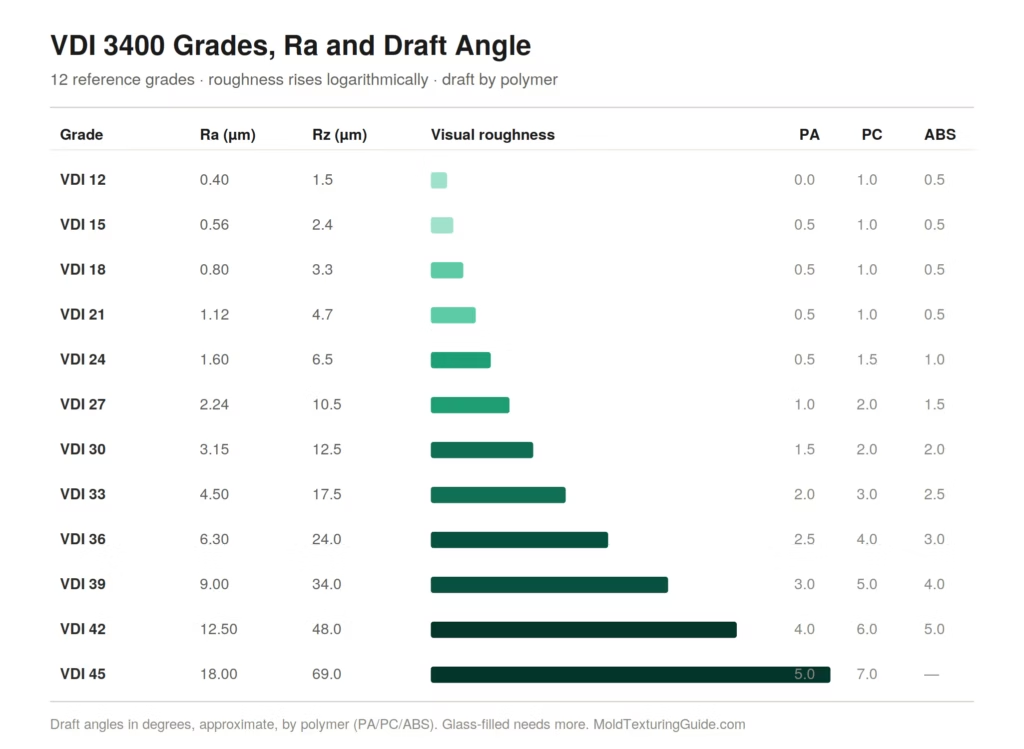
VDI 3400 is the German standard for EDM-textured mold surface roughness, the most widely used roughness reference worldwide. It is applied as 12 reference grades, from VDI 12 (smoothest) to VDI 45 (roughest), with arithmetic average roughness rising from about Ra 0.40 to 18.00 micrometers. The scale is logarithmic: every 6-unit increase in the VDI number roughly doubles the surface roughness. This page explains what VDI 3400 is, how it is produced, the full grade table with Ra and draft data, and how to choose a grade.
What is VDI 3400 surface finish?
VDI 3400 is a mold texture standard set by the Verein Deutscher Ingenieure, the Society of German Engineers. It specifies surface roughness, the controlled coarseness of a mold cavity, and is most often used to define matte and textured finishes produced by Electrical Discharge Machining (EDM). Although it originated in Germany, it has become the dominant roughness reference for toolmakers across Europe, Asia, and North America, which is why it is treated as a global standard rather than a regional one.
The key idea behind VDI 3400 is that it focuses on roughness rather than smoothness. Where the American SPI standard describes how polished a surface is, VDI 3400 describes how rough it is, using a single numeric grade that corresponds to a defined Ra value. That makes specification simple and unambiguous: an engineer writes "VDI 27" on a drawing, and a toolmaker anywhere in the world knows exactly what surface to produce.
How many grades does VDI 3400 have?
This is the most common point of confusion about the standard, because sources disagree. Some say VDI 3400 has 45 grades, others say 12. Both numbers come from the same place, and understanding why resolves the confusion.
The underlying scale, derived from the Charmilles CH reference system, runs continuously from 0 to 45. That is the source of the "45 grades" claim. In practice, however, injection molding specifies a defined set of 12 reference grades, spaced three units apart: VDI 12, 15, 18, 21, 24, 27, 30, 33, 36, 39, 42, and 45. These twelve are the grades that appear on drawings and on physical reference cards. So the honest answer is that VDI 3400 is built on a 0 to 45 scale but is used as 12 reference grades in molding practice.
The VDI 3400 grade and Ra table
Each VDI grade corresponds to a specific arithmetic average roughness (Ra) and a maximum roughness depth measured as Rz. The smoothest reference grade, VDI 12, sits at Ra 0.40 µm, and the roughest, VDI 45, reaches Ra 18.00 µm. The table below gives the full set.
| VDI grade | Ra (µm) | Rz (µm) |
|---|---|---|
| VDI 12 | 0.40 | 1.5 |
| VDI 15 | 0.56 | 2.4 |
| VDI 18 | 0.80 | 3.3 |
| VDI 21 | 1.12 | 4.7 |
| VDI 24 | 1.60 | 6.5 |
| VDI 27 | 2.24 | 10.5 |
| VDI 30 | 3.15 | 12.5 |
| VDI 33 | 4.50 | 17.5 |
| VDI 36 | 6.30 | 24.0 |
| VDI 39 | 9.00 | 34.0 |
| VDI 42 | 12.50 | 48.0 |
| VDI 45 | 18.00 | 69.0 |
Source: VDI 3400 reference comparison standards (Charmilles/Agie scale).
Why roughness doubles every few grades
An important property of the VDI scale that many references omit is that it is logarithmic, not linear. The roughness does not increase by a fixed amount per grade; it increases by a fixed ratio. In practical terms, every 6-unit increase in the VDI number roughly doubles the surface roughness.
This explains why the jump from VDI 12 to VDI 18 (Ra 0.40 to 0.80) doubles the roughness, and the jump from VDI 18 to VDI 24 (Ra 0.80 to 1.60) doubles it again. Understanding this logarithmic behavior helps when selecting a grade: moving up a few numbers has a much larger effect at the rough end of the scale than the numbers alone suggest. It also explains why the visual difference between adjacent grades is subtle at the smooth end and dramatic at the rough end.
How is VDI 3400 texture made?
VDI 3400 finishes are produced mainly by Electrical Discharge Machining (EDM). In EDM, a shaped electrode, typically copper or high-density graphite, is brought close to the mold steel while both are submerged in a dielectric fluid. Controlled electrical sparks jump the gap and erode the steel surface, melting and vaporizing tiny amounts of material. The result is a uniform, non-directional matte texture across the cavity.
The roughness is controlled by the discharge energy. Increasing the current and pulse duration removes more material per spark and produces a coarser texture, moving up the VDI scale; reducing them produces a finer texture. Because the texture is a natural product of the machining process rather than a separate finishing step, EDM-produced VDI textures are highly uniform and repeatable, which is one of the standard's main advantages over hand-applied finishes.
While EDM is the dominant method, a VDI-equivalent roughness can also be approached by other texturing methods, but EDM remains the reference process and the one the standard is built around. For more on the process itself, see EDM texturing.
VDI 3400 and draft angle
Surface roughness and draft angle are linked. The rougher the texture, the more draft a part needs so it can eject from the mold without scuffing or dragging along the cavity wall. With VDI 3400, the required draft rises with the grade number and also depends on the polymer being molded.
As a guide, a moderate grade such as VDI 24 typically requires a minimum draft of about 1.5 to 2.0 degrees, while a coarse grade such as VDI 36 needs at least 4.0 degrees. Glass-filled polymers, which are more abrasive and less forgiving on ejection, require more draft than the unfilled values. The table in the image above gives approximate minimum draft angles by grade for polyamide (PA), polycarbonate (PC), and ABS. These are starting points; always confirm with the toolmaker and account for part geometry. The full treatment is on the draft angle by texture grade page.
Which VDI grade should you choose?
The right grade follows from the part's appearance and function. A few practical anchors cover most cases.
For a subtle, near-smooth matte that still reads as finished, the low grades (VDI 12 to 18) are appropriate. For consumer electronics and handheld devices, the middle of the scale works well: VDI 24 to VDI 30 gives a premium tactile feel that resists the greasy look of polished plastics while keeping ejection manageable. For surfaces where grip or a pronounced texture matters, the higher grades (VDI 33 and up) deliver a coarse, matte appearance, at the cost of needing significantly more draft.
Two practical reminders apply across all grades. First, because the scale is logarithmic, a small change in grade number at the rough end is a large change in actual texture, so move carefully there. Second, always validate a chosen grade against a physical reference plaque before finalizing, since the same VDI number can read slightly differently on different polymers and colors.
VDI 3400 compared to SPI and Mold-Tech
VDI 3400 is one of three dominant mold texture standards, alongside SPI and Mold-Tech. The clearest distinction is purpose: VDI 3400 is a roughness standard built around EDM texture, SPI is a US polish standard built around smoothness, and Mold-Tech is a proprietary library of decorative patterns. They overlap only approximately, in the matte middle of the range, and there is no official conversion between them.
Any cross-reference is based on matching Ra values and should be treated as a starting point, not an equivalence. For the detailed, sourced comparison, see the SPI to VDI 3400 to Mold-Tech conversion page, the SPI surface finish reference, and the overview on the mold texture standards hub.
Frequently asked questions
What is VDI 3400 surface finish?
A German mold texture standard for EDM-textured surface roughness, the most widely used roughness reference worldwide, applied as 12 reference grades from VDI 12 to VDI 45.
How many grades does VDI 3400 have?
Twelve official reference grades in molding (12 to 45). The underlying Charmilles CH scale runs from 0 to 45, which is the source of the "45 grades" description.
What are the Ra values for VDI 3400?
From Ra 0.40 µm (VDI 12) to Ra 18.00 µm (VDI 45). The values rise logarithmically.
How is VDI 3400 texture made?
Mainly by EDM, using a shaped copper or graphite electrode in dielectric fluid to erode a uniform, non-directional texture. Discharge energy controls the roughness.
Why does roughness double every few grades?
The scale is logarithmic. Every 6-unit increase in the VDI number roughly doubles the surface roughness.
Which VDI grade is best for consumer electronics?
VDI 24 to 30 is common, giving a premium tactile feel that resists greasiness while keeping easy part ejection.
What draft angle does VDI 3400 need?
It rises with the grade. VDI 24 needs roughly 1.5 to 2.0 degrees; VDI 36 needs at least 4.0 degrees; glass-filled polymers need more.
Is VDI 3400 the same as SPI?
No. SPI is a US polish standard focused on smoothness; VDI 3400 is a roughness standard focused on EDM texture. They relate only approximately, through Ra.
Normative References & Sources
- Verein Deutscher Ingenieure (VDI) — VDI 3400 standard: vdi.de
- ISO 1302 — Surface texture indication: iso.org
- VDI 3400 / Charmilles CH reference comparison standards (Ra and Rz per grade).
Reviewed by Marcel Dias — Technical Editor. Grade, Ra, and draft values are provided for reference and are approximate; verify against the primary standard and a physical sample before production. See our Disclaimer.
Leave a Reply