SPI to VDI 3400 to Mold-Tech Conversion Chart
There is no official cross-conversion between SPI, VDI 3400, and Mold-Tech. The three
mold texture standards align only approximately, through their surface roughness (Ra) values. VDI 3400
spans Ra 0.40 to 18.00 µm across its 12 reference grades (VDI 12 to VDI 45); SPI spans roughly Ra 0.012
to 18 µm across grades A1 to D3; Mold-Tech is a proprietary texture library with no official numeric
cross-reference. Any conversion below is for reference only and should be confirmed with a toolmaker
before production.
Why there is no exact conversion
Each standard was created for a different purpose. SPI (set by the Society of the Plastics Industry,
now the Plastics Industry Association) describes mold polish, from mirror gloss to coarse texture, and is
the dominant reference in North America. VDI 3400 (from the Verein Deutscher Ingenieure) describes
EDM-textured roughness and is the most widely used roughness reference worldwide. Mold-Tech is a
proprietary texture catalog from Standex. Because they measure and define surfaces differently, they can
only be related approximately, by matching their Ra ranges. This is why published conversion charts
disagree with one another.
VDI 3400 grades and Ra values
In injection molding, VDI 3400 is used as a set of 12 reference grades, from VDI 12 (smoothest) to
VDI 45 (roughest). The underlying Charmilles CH scale runs from 0 to 45, which is why some sources
describe VDI 3400 as having 45 grades; in practice, the 12 reference grades below are the ones specified
on drawings.
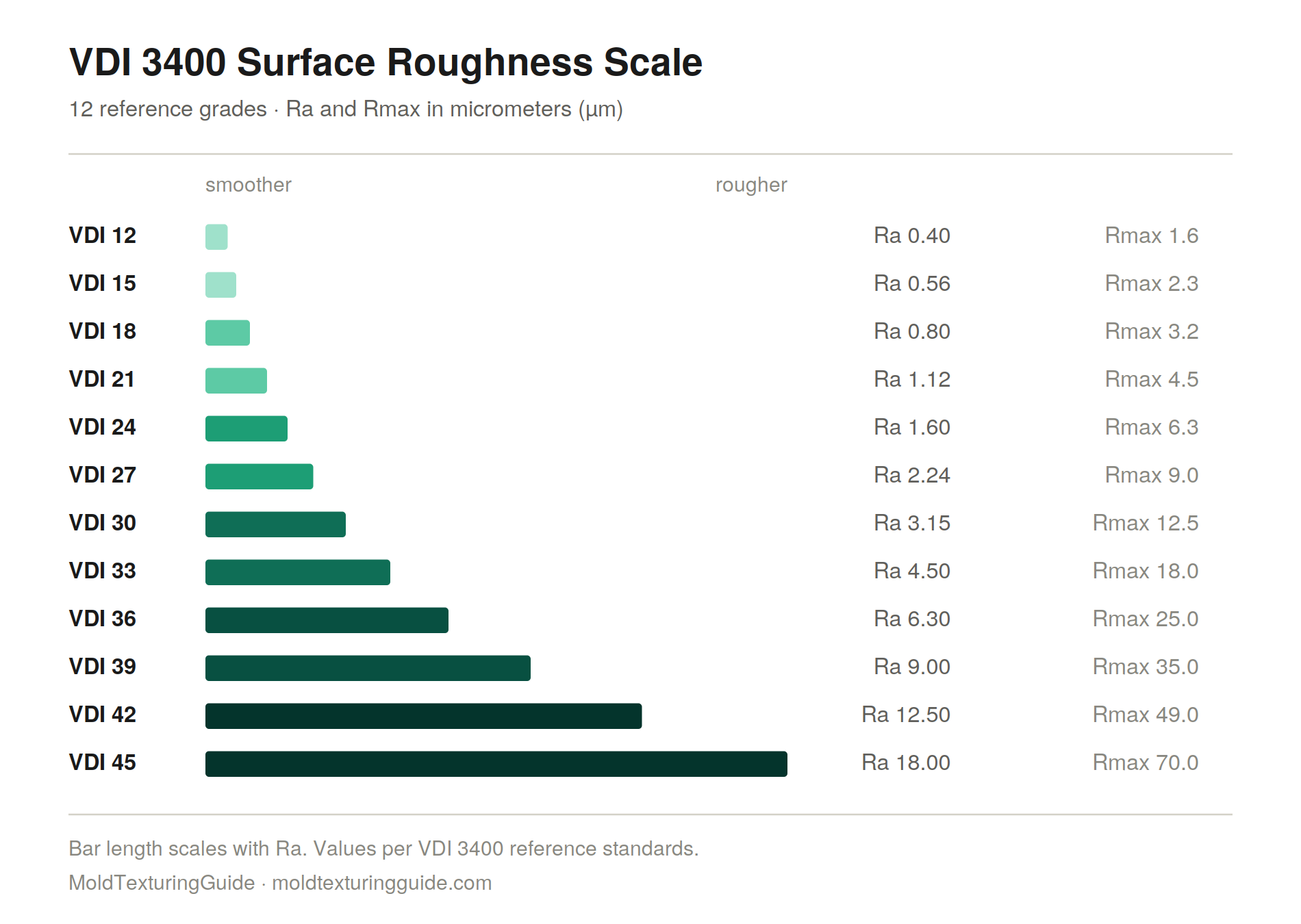
| VDI 3400 grade | Ra (µm) | Rmax (µm) |
|---|---|---|
| VDI 12 | 0.40 | 1.6 |
| VDI 15 | 0.56 | 2.3 |
| VDI 18 | 0.80 | 3.2 |
| VDI 21 | 1.12 | 4.5 |
| VDI 24 | 1.60 | 6.3 |
| VDI 27 | 2.24 | 9.0 |
| VDI 30 | 3.15 | 12.5 |
| VDI 33 | 4.50 | 18.0 |
| VDI 36 | 6.30 | 25.0 |
| VDI 39 | 9.00 | 35.0 |
| VDI 42 | 12.50 | 49.0 |
| VDI 45 | 18.00 | 70.0 |
Source: EDM/VDI 3400 reference comparison standards (Charmilles/Agie scale).
SPI finish grades and approximate Ra
SPI defines 12 grades in four categories: A (glossy, diamond buffing), B (semi-gloss, grit paper),
C (matte, stone), and D (textured, dry blasting). Reported Ra values vary noticeably between sources, so
the ranges below are approximate.
| SPI category | Grades | Finishing method | Approx. Ra (µm) |
|---|---|---|---|
| A — Glossy | A1, A2, A3 | Diamond buffing | ~0.012 – 0.10 |
| B — Semi-gloss | B1, B2, B3 | Grit paper | ~0.10 – 0.80 |
| C — Matte | C1, C2, C3 | Stone abrasive | ~0.80 – 6.30 |
| D — Textured | D1, D2, D3 | Dry blasting | ~1.00 – 18.00+ |
Approximate, not official. SPI Ra values diverge across sources; some charts list D3 well above 18 µm. Verify against the primary standard.
Approximate SPI to VDI cross-reference
Because both standards can be expressed in Ra, an approximate bridge is possible at the extremes.
As a rough guide, SPI A3 corresponds roughly to VDI #0 to #5, and SPI D3 corresponds roughly to VDI #30
to #45. These are reference points, not equivalences, and should never replace a physical sample or a
toolmaker's confirmation.
How does texture affect draft angle?
Rougher textures require larger draft angles for clean ejection, and the required angle depends on the
polymer. The table below gives minimum draft angle guidance by VDI grade for three common materials.
Glass-filled grades require more draft than the values shown.
| VDI grade | Ra (µm) | Rz (µm) | PA (°) | PC (°) | ABS (°) |
|---|---|---|---|---|---|
| VDI 12 | 0.4 | 1.5 | 0.0 | 1.0 | 0.5 |
| VDI 15 | 0.6 | 2.4 | 0.5 | 1.0 | 0.5 |
| VDI 18 | 0.8 | 3.3 | 0.5 | 1.0 | 0.5 |
| VDI 21 | 1.1 | 4.7 | 0.5 | 1.0 | 0.5 |
| VDI 24 | 1.6 | 6.5 | 0.5 | 1.5 | 1.0 |
| VDI 27 | 2.2 | 10.5 | 1.0 | 2.0 | 1.5 |
| VDI 30 | 3.2 | 12.5 | 1.5 | 2.0 | 2.0 |
| VDI 33 | 4.5 | 17.5 | 2.0 | 3.0 | 2.5 |
| VDI 36 | 6.3 | 24.0 | 2.5 | 4.0 | 3.0 |
| VDI 39 | 9.0 | 34.0 | 3.0 | 5.0 | 4.0 |
| VDI 42 | 12.5 | 48.0 | 4.0 | 6.0 | 5.0 |
| VDI 45 | 18.0 | 69.0 | 5.0 | 7.0 | — |
Approximate guidance. Draft angle values vary by source and depend on part geometry, polymer grade, and processing. Confirm with your toolmaker. PA = polyamide, PC = polycarbonate, ABS = acrylonitrile butadiene styrene.
Frequently asked questions
Is there an official conversion between SPI, VDI 3400, and Mold-Tech?
No. They are separate standards related only approximately through their Ra ranges; any conversion is for
reference and should be verified with your toolmaker.
How many grades does VDI 3400 have?
In injection molding, 12 reference grades from VDI 12 to VDI 45. The underlying Charmilles CH scale runs
from 0 to 45, which is the source of the "45 grades" description.
What is the Ra range of VDI 3400?
From Ra 0.40 µm (VDI 12) to Ra 18.00 µm (VDI 45) across the 12 reference grades.
What is the Ra range of SPI finishes?
Approximately Ra 0.012 µm (A1) to about 18 µm (D3). Exact values vary by source.
Which SPI grade roughly matches a given VDI grade?
As a rough guide, SPI A3 ≈ VDI #0–#5 and SPI D3 ≈ VDI #30–#45. Treat these as reference points only.
Why do published conversion charts disagree?
Because there is no official cross-conversion. Each source approximates from Ra differently, so values
diverge.
Is Mold-Tech the same as VDI?
No. Mold-Tech is a proprietary Standex texture library with no official numeric cross-reference to VDI;
only approximate Ra-based equivalences exist.
Does texture affect the required draft angle?
Yes. Rougher VDI grades need more draft, and glass-filled polymers need more still. For example, VDI 30
needs roughly 1.5 to 2 degrees depending on the material.
Related standards and design pages
For the individual standards, see VDI 3400
surface finish, SPI surface
finish, and Mold-Tech
textures. For ejection design, see draft
angle by texture grade. Definitions of terms used here are in the
glossary, and the full
mold texture standards hub lists every standard we
cover.
Normative References & Sources
- Verein Deutscher Ingenieure (VDI) — VDI 3400 standard: vdi.de
- Plastics Industry Association (formerly SPI): plasticsindustry.org
- ISO 1302 — Surface texture indication: iso.org
- VDI 3400 / Charmilles CH reference comparison standards (Ra and Rmax per grade).
Reviewed by Marcel Dias — Technical
Editor. Conversions between standards are approximate and provided for reference only; verify against
the primary standard and your toolmaker before production. See our
Disclaimer.
Leave a Reply