SPI Surface Finish: Grades, Ra Values and Finishing Methods
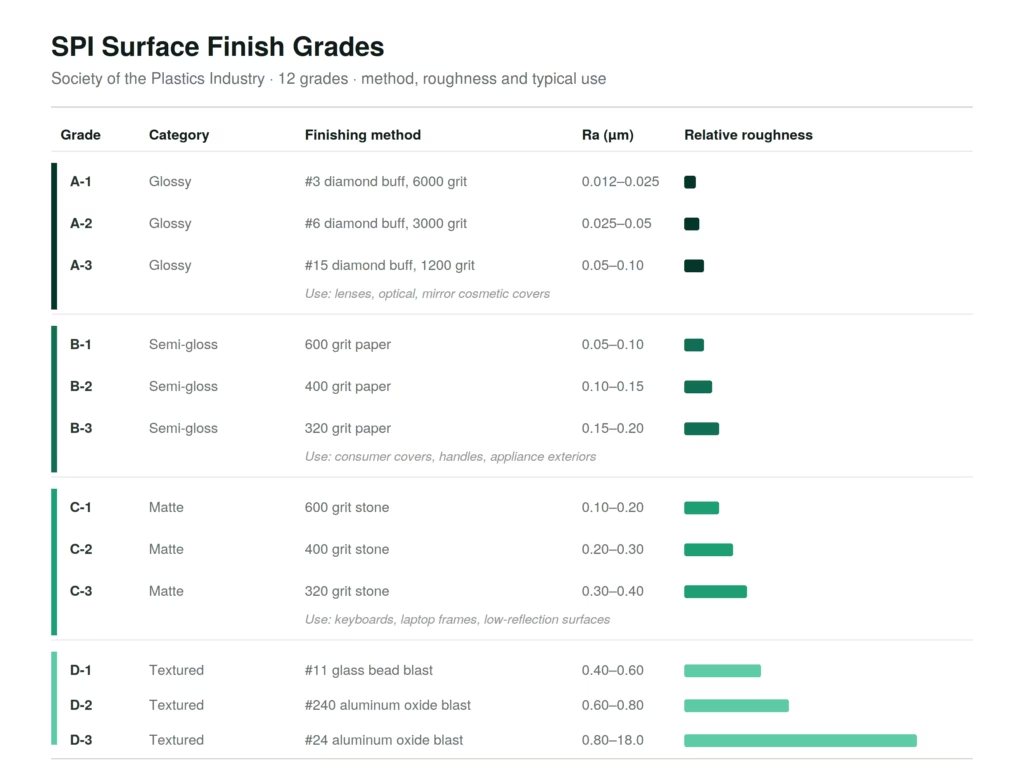
SPI surface finish is the American mold finish standard from the Society of the Plastics Industry, now the Plastics Industry Association. It defines 12 grades of polish from A-1 to D-3, organized into four categories: glossy (A, diamond buffing), semi-gloss (B, grit paper), matte (C, grit stone), and textured (D, dry blasting). The grades span roughly Ra 0.012 µm at the mirror-polished A-1 to Ra 18.00 µm at the blasted D-3. Importantly, each SPI grade is defined by its finishing method and resulting appearance, not by a roughness number alone. This page explains the categories, the full grade table, how the finishes are made, how polymer and process affect the result, and how to choose.
What is SPI surface finish?
SPI surface finish is a system for specifying how a mold cavity is polished or textured, and therefore how the molded plastic part will look and feel. It was defined by the Society of the Plastics Industry, a US trade association now known as the Plastics Industry Association, and it is the dominant finish language in North America. Although it is an American standard, it is used by mold makers worldwide, and an engineer in the US can send an SPI callout to an offshore toolmaker and expect a consistent result.
The key idea that separates SPI from a pure roughness standard is that it describes a finishing process and an appearance, not only a measured roughness. An SPI grade tells the toolmaker which method to use, diamond buffing, grit paper, grit stone, or blasting, and what visual result to aim for, from mirror gloss to coarse texture. Two surfaces can share a similar roughness number yet look quite different depending on how they were produced, which is why SPI anchors on method and appearance rather than on Ra alone.
Where SPI is used: geographic adoption
SPI is the default finish standard in North America, where it is written into most tooling specifications and understood by every mold shop. Its reach, however, extends well beyond the United States. Because so much injection tooling is built in Asia, particularly in China, SPI callouts are routinely accepted and reproduced by offshore toolmakers, who often work to SPI and VDI 3400 interchangeably depending on the customer's origin.
In Europe and much of Asia, the German VDI 3400 roughness standard is the more common reference for textured and matte finishes, while SPI remains the preferred language for polish and gloss. In practice, many global suppliers maintain fluency in both: SPI for the smoothness end and VDI for the roughness end. In Latin America, including Brazil, the market follows a mixed practice, with shops referencing whichever standard the end customer or the part's destination market requires. The practical takeaway is that SPI is not a regional curiosity but a widely recognized polish standard, even in markets where VDI dominates texture.
The four SPI categories
The twelve SPI grades fall into four lettered categories, each tied to a finishing method and a level of gloss. Within each category there are three sub-levels, numbered 1, 2, and 3, where 1 is the finest and 3 the coarsest of that category.
A, glossy. Produced by diamond buffing, the A category delivers the smoothest, shiniest surfaces, from the mirror-like A-1 down to A-3. These finishes suit transparent and high-gloss parts such as lenses, light pipes, and cosmetic covers where reflection or optical clarity matters.
B, semi-gloss. Produced with grit sandpaper, the B category gives an intermediate sheen, smoother than matte but not mirror-like. It works well for consumer parts, covers, and handles that need a clean, lightly reflective look without the cost of a full polish.
C, matte. Produced with grit stones, the C category creates dull, low-reflection surfaces. Matte finishes are common on keyboards and laptop frames because they reflect less light and make fingerprints less noticeable on frequently handled products, and they support a deliberately subdued appearance.
D, textured. Produced by dry or pressure blasting with glass beads or aluminum oxide, the D category produces rough, non-reflective surfaces. Textured finishes are used on parts meant to be gripped, such as shop vacuums and steering wheels, and they help hide molding imperfections like flow lines.
The SPI grade table
The table below lists the twelve grades with their category, typical finishing method, and an approximate Ra range. A note on the numbers follows, because the per-grade values deserve honesty.
| Grade | Category | Finishing method | Approx. Ra (µm) |
|---|---|---|---|
| A-1 | Glossy | #3 diamond buff (6000 grit) | 0.012 to 0.025 |
| A-2 | Glossy | #6 diamond buff (3000 grit) | 0.025 to 0.05 |
| A-3 | Glossy | #15 diamond buff (1200 grit) | 0.05 to 0.10 |
| B-1 | Semi-gloss | 600 grit paper | 0.05 to 0.10 |
| B-2 | Semi-gloss | 400 grit paper | 0.10 to 0.15 |
| B-3 | Semi-gloss | 320 grit paper | 0.15 to 0.20 |
| C-1 | Matte | 600 grit stone | 0.10 to 0.20 |
| C-2 | Matte | 400 grit stone | 0.20 to 0.30 |
| C-3 | Matte | 320 grit stone | 0.30 to 0.40 |
| D-1 | Textured | #11 glass bead blast | 0.40 to 0.60 |
| D-2 | Textured | #240 aluminum oxide blast | 0.60 to 0.80 |
| D-3 | Textured | #24 aluminum oxide blast | 0.80 to 18.0 |
Ra ranges are approximate and vary by source. Use them as a guide, not an exact specification.
A note on Ra values: why sources disagree
If you compare SPI charts from different suppliers, you will notice the per-grade Ra values do not match. This is not carelessness; it reflects a few real issues. Some charts report Ra in microinches and others in micrometers, and unit conversions introduce rounding. Different shops achieve slightly different results with the same nominal method, depending on operator skill and equipment. And because SPI is built around method and appearance rather than a single roughness target, the same grade can land in a small range of Ra rather than a fixed point.
The honest way to use SPI is therefore to treat the per-grade Ra figures as approximate ranges, anchor on the consensus endpoints, A-1 near Ra 0.012 µm and D-3 reaching up to Ra 18.00 µm, and rely on a physical reference plaque for the final decision. Stating this openly is more useful than presenting a single "exact" table that quietly disagrees with the next supplier's chart.
How SPI finishes are made
Each category corresponds to a distinct finishing process applied to the mold steel after machining. Reaching a given grade is a sequence: the surface is worked through progressively finer steps until the target finish is achieved.
The glossy A grades are reached by diamond buffing, using diamond paste or compound of decreasing grit, which is slow, skilled work. The semi-gloss B grades use grit sandpaper. The matte C grades use grit sanding stones. The textured D grades use dry blasting media, glass beads for finer textures and aluminum oxide for coarser ones. Because the finer grades require completing each coarser step first, the work and cost accumulate as the finish gets smoother.
Steel matters as much as method
A point many SPI charts omit is that the mold steel itself affects the achievable finish. High-chrome, high-hardness steels such as S136 or 420 stainless polish to a higher gloss and hold a fine finish far better than a general-purpose steel like P20. At the same nominal SPI grade, a part molded from a tool in S136 can look cleaner and more uniform than one from P20, because the harder, more homogeneous steel takes polishing better and resists the micro-scratches that dull a surface.
This is why a high-gloss A-1 or A-2 finish is usually specified together with an appropriate steel. Asking for a mirror finish on a soft or porous steel sets up disappointment. When you specify an SPI grade at the top of the range, confirm the mold steel can support it.
The polymer changes the result
The same SPI cavity finish does not produce the same part surface on every plastic. The polymer's molecular structure is one of the strongest factors in the final appearance, and understanding it prevents specifying a finish the material cannot deliver.
Amorphous polymers, such as PC, PMMA, and ABS, generally achieve higher gloss and reproduce a polished cavity more faithfully, because they lack the ordered lamellar structures that scatter light and because they shrink more uniformly during cooling. Semi-crystalline polymers, such as PP, PE, and POM, tend to shrink more and less uniformly, which produces duller, sometimes wavy surfaces and a higher risk of the orange-peel effect. Research on textured molding has found that crystalline polymers generally show higher surface roughness than amorphous ones, and that higher roughness corresponds to clearer, more distinct texture reproduction while lower roughness can leave a pattern looking blurred.
Fillers and reinforcements shift the result again. Glass fibers and mineral fillers disrupt the continuity of the polymer skin and raise surface roughness, which lowers specular reflection and makes a true high-gloss A finish hard to achieve in a filled grade. Pigment particle size and dispersion also matter: fine, evenly dispersed pigments keep gloss uniform, while coarse or poorly dispersed pigment can mottle the surface. For reinforced resins, raising the mold temperature can recover some gloss and reduce roughness.
Common surface defects to anticipate
Even with the correct SPI grade and steel, the molding process can introduce surface defects that no polish can fix. Knowing the main ones helps separate a finish problem from a process problem.
Orange peel is a rippled, pitted surface resembling citrus skin, typically appearing at the end of the flow path in thick-walled parts molded from high-viscosity material, or when the surface solidifies too quickly at low injection speed. Blush is a localized area of dullness or cloudiness, usually around the gate. The gloss-transition defect, alternating glossy and dull zones, arises when melt flow and pressure are unstable during filling, because mold-surface replication depends on the polymer skin staying in intimate contact with the cavity wall as it solidifies. The practical lesson is that the final surface is an interaction of material, tooling, and process: a flawless A-2 cavity will still disappoint if packing pressure, melt temperature, or wall-thickness design work against replication.
Cost and lead time by category
Finish has a direct effect on tooling cost and schedule. The A category is the most expensive, because diamond polishing is skilled manual labor, requires high-hardness steel, and accumulates time as each finer step is completed in turn. High-polish finishes can add one to two weeks to a tooling build. At the other end, the D category is the most economical, since blasting is fast and less labor-intensive. As a general rule, the shinier and smoother the finish, the higher the mold cost and the longer the lead time.
This cost gradient is worth keeping in mind at the design stage. If a part does not need gloss, specifying a matte C or textured D finish is not only an aesthetic choice but a cost saving, and it can also hide minor molding defects that a glossy surface would reveal.
SPI and ISO 1302
SPI is a finishing-method and appearance standard, not a metrological one. When a project needs to express surface texture in formal engineering terms, the international reference is ISO 1302, which standardizes how surface texture is indicated on technical drawings, including Ra. SPI and ISO 1302 are complementary rather than competing: SPI tells the shop how to finish the cavity and what it should look like, while ISO 1302 provides the drawing notation and the measurable roughness parameter. For parts that must satisfy both a visual specification and a measurable roughness tolerance, the two are used together.
The mold finish is not exactly the part finish
An SPI callout describes the finish on the mold cavity, not a guaranteed result on the finished plastic part. The final appearance of the part depends on the polymer, the colorant, the processing conditions, and the mold steel, as well as the cavity finish. A glossy cavity generally yields a glossy part, but the exact gloss and texture can shift with material and process. For parts where the surface must match precisely, a physical sample and an agreed reference are essential, and a more detailed texture specification may be needed.
Which SPI finish should you choose?
The right grade follows from the part's appearance and function. A few practical anchors cover most cases: optical and mirror parts call for A-1 to A-2; high-gloss consumer parts for A-2 to B-1; appliance exteriors for B-1 to B-3; matte surfaces such as keyboards and laptop frames for C-1 to C-3; and grip or heavily textured surfaces for D-1 to D-3.
Beyond the look, weigh material, steel, and cost together. If the part is a semi-crystalline polymer, do not specify a mirror A finish and expect glass-clear gloss; the material will not deliver it. If gloss is essential, choose an amorphous resin, an appropriate high-chrome steel, and budget for the polishing time. If gloss is not essential, a matte or textured finish saves money and hides defects. And in every case, confirm the choice against a physical plaque, since the same grade reads differently across polymers and colors.
SPI compared to VDI 3400 and Mold-Tech
SPI is one of three dominant mold texture standards. The clearest distinction is purpose: SPI is a US polish standard built around smoothness and finishing method, VDI 3400 is a German roughness standard built around EDM texture, and Mold-Tech is a proprietary library of decorative patterns. They overlap only approximately, in the matte middle of the range, and there is no official conversion between them.
Any cross-reference is based on matching Ra and should be treated as a starting point, not an equivalence. For the detailed, sourced comparison, see the SPI to VDI 3400 to Mold-Tech conversion page, the Mold-Tech textures reference, and the overview on the mold texture standards hub.
Frequently asked questions
What is SPI surface finish?
The American mold finish standard from the Society of the Plastics Industry, defining 12 grades A-1 to D-3 in four categories: glossy, semi-gloss, matte, and textured.
How many SPI finish grades are there?
Twelve: A-1, A-2, A-3, B-1, B-2, B-3, C-1, C-2, C-3, D-1, D-2, and D-3.
What are the four SPI categories?
A glossy (diamond buffing), B semi-gloss (grit paper), C matte (grit stone), and D textured (dry blasting).
What is the Ra range of SPI finishes?
About Ra 0.012 µm at A-1 up to Ra 18.00 µm at D-3. Intermediate values vary by source, so treat them as approximate.
Why is SPI not just about Ra?
SPI specifies the finishing method and the resulting appearance, gloss, reflection, and clarity, which a single roughness number cannot fully capture.
Does the polymer affect the SPI result?
Strongly. Amorphous polymers (PC, ABS, PMMA) reach higher gloss and reproduce a polish more faithfully; semi-crystalline polymers (PP, PE, POM) shrink more and tend to be duller, with a higher orange-peel risk. Glass fillers raise roughness and reduce gloss.
Which SPI finish is most expensive?
Category A (glossy), because diamond polishing is skilled labor, needs high-hardness steel, and accumulates time. Category D (blasting) is the most economical.
Does the mold steel affect the result?
Yes. High-chrome steels such as S136 or 420 polish to a higher gloss and hold a fine finish better than P20 at the same grade.
Is SPI the same as VDI 3400?
No. SPI is a US polish standard focused on smoothness; VDI 3400 is a roughness standard focused on EDM texture. They relate only approximately, through Ra.
Normative References & Sources
- Plastics Industry Association (formerly Society of the Plastics Industry): plasticsindustry.org
- ISO 1302 — Surface texture indication: iso.org
- ISO 25178 — Areal surface texture characterization (research reference).
- SPI mold finish comparison references (per-grade method and Ra, values approximate).
Reviewed by Marcel Dias — Technical Editor. Grade and Ra values are provided for reference and are approximate; the mold callout differs from the final part finish. Verify against the primary standard and a physical sample before production. See our Disclaimer.
Leave a Reply